

-From the Journal
A few reflections inspired by life with Cora and Robbie.
These essays explore the quiet lessons I've discovered through sharing my life with two rescued cows. Some are rooted in research, others in simple moments from the pasture, but all are written from a place of curiosity and wonder.
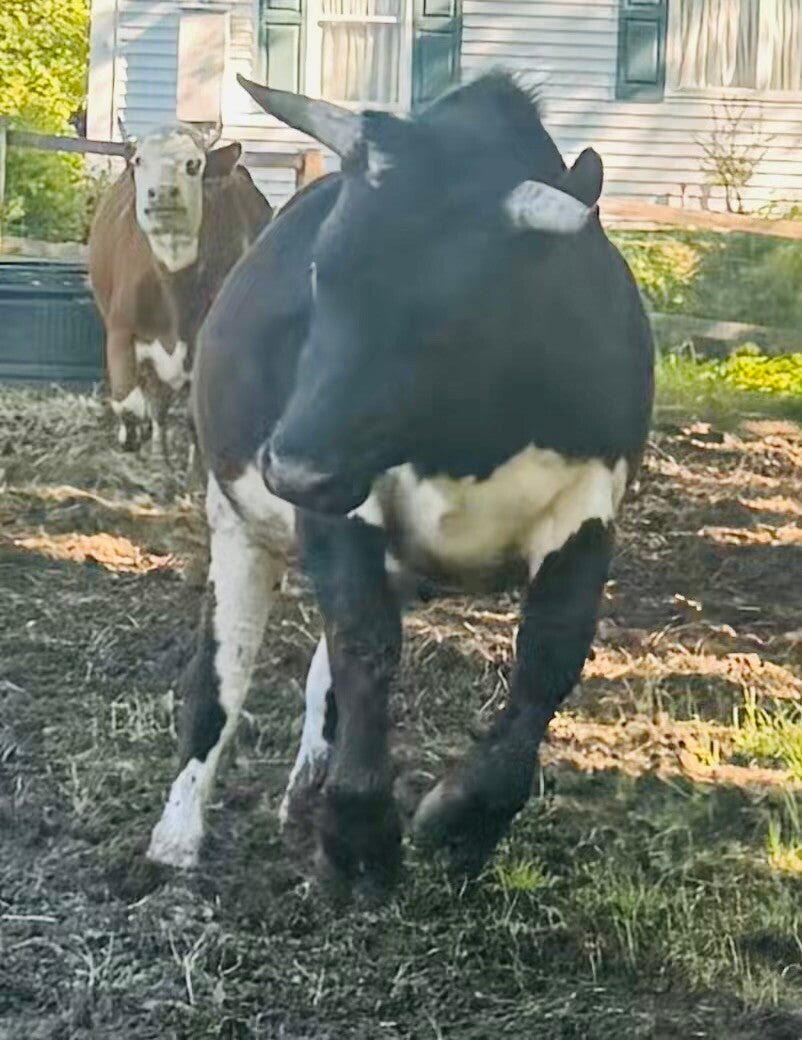
Robbie kicking up his heals
The other day, Scott was outside on a ladder doing something with the cameras when he called for me.
Cora and Robbie were standing at the bottom of the ladder.
I came outside and ran in the opposite direction, and of course they followed me.
Then, seemingly out of nowhere, Robbie banged his hanging ball with his enormous head and took off down the hill, kicking up his heels — not once, but again and again. Five times, maybe. Pure exuberance.
A few minutes later, I was picking some grass just outside the pasture when he came running back toward me at full speed.
Robbie is a very large animal.
There is a particular experience involved in watching that much cow coming directly at you.
But just before he reached me, he stopped.
And that was it.
There was no lesson.
No exercise in mindfulness. No list of ways to experience more joy. No suggestion that anyone set an intention, develop a practice, or become a better version of themselves.
There was just Robbie.
Banging his ball.
Kicking up his heels.
Running toward me.
Stopping.
Being completely, gloriously alive.
I spent many years interested in holistic health and wellness, and I still am. I learned things that changed my life and became part of me. But for a while, I think I was trying too hard to turn what I knew into something I could teach.
These days, I find myself much more interested in what happens when I stop trying to teach anything at all.
Because somewhere inside that completely unscripted moment with Robbie was probably more truth about joy and being alive than I could have forced into fifty wellness posts.
Maybe joy doesn't always need to be understood.
Maybe it doesn't need a framework.
Maybe sometimes it has four legs, an enormous black head, and a hanging ball it suddenly decides to wallop for no apparent reason.
And maybe sometimes we're lucky enough to be standing there when it happens.
Intentional Simplicity
I've been thinking about something I value very much at Heartstone Farm: intentional simplicity.
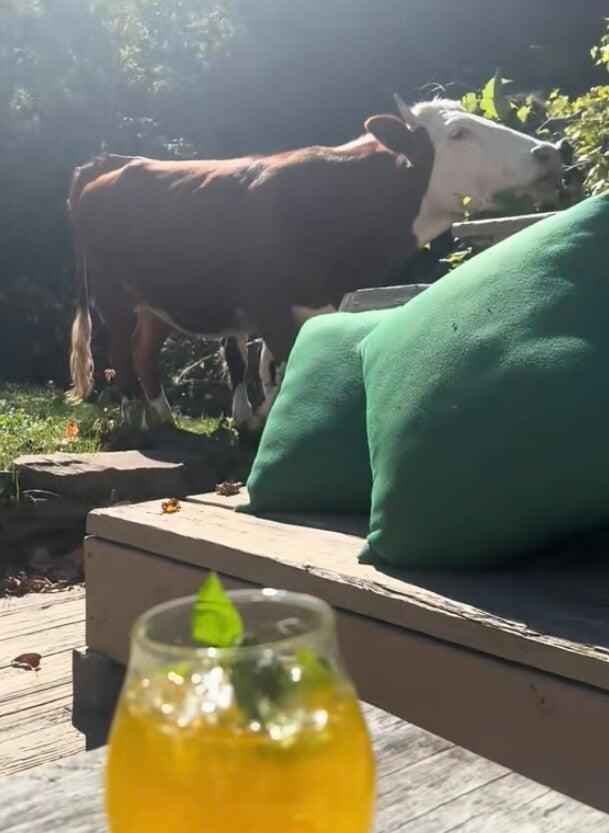
A Cow Connection isn't packed with activities. There isn't a schedule of things you have to do with Cora and Robbie. Nothing needs to happen.
You might groom them. You might offer them a treat. You might sit in the grass. You might talk. You might be quiet. And the cows themselves get a vote in all of it.
The simplicity is intentional.
I think so much of life is designed to keep us occupied, entertained, moving on to the next thing. Here, I want there to be enough space for something quieter to happen. To notice. To become curious. To see the difference between Cora and Robbie. To realize they're noticing you, too.
That's the space where the magic occurs.
It's the space where you can discover what happens when nobody is trying very hard to make a moment happen.
Sometimes very little happens here. And somehow, those can be the moments that stay with us the longest.
Maybe that's what intentional simplicity means to me. Not that there isn't much here.
That there's finally enough room to notice what is.
Late Summer Nights
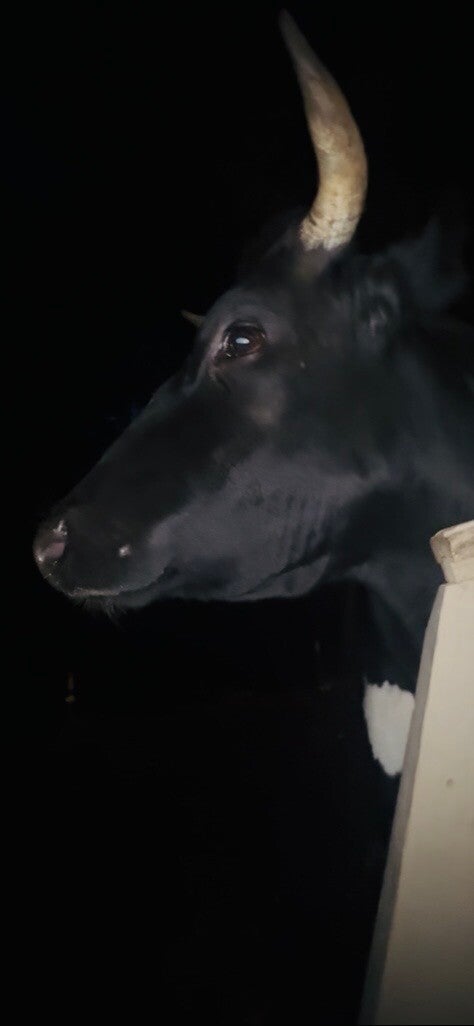
Late at night, when everything is done, I sometimes go back outside to see Cora and Robbie.
These late summer nights with them may be my favorite.
There's nothing to do.
No grooming basket. No guests. No treats necessary, although scratches are accepted. There isn't even much light. Sometimes it's just the light from my phone catching Robbie's enormous black head beside me, or Cora's white eyelashes appearing out of the darkness.
We just hang there... you could cut the peace with a knife!
Last night they seemed more eager than usual to simply be close.
Ahhhhhhhh.... there it was—another soul soothing moment with Cora and Robbie that I didn't even know I needed.
Our intimacy has evolved so simply....
We like being together.
That's it.
I found myself trying to explain this recently to a guest. I said that the cows and I cuddle all the time, but that kind of closeness is difficult to recreate during a visit.
Of course it is.
What happens between us at night isn't arranged... it's accumulated.
I've sat with them in the barn in winter. I've laid beside them in the dirt. I've walked out to see them for five minutes and somehow stayed for an hour. I've gone looking for them because I needed them, and I suspect there have been times they've come looking for me simply because they wanted me there.
Thousands of tiny moments.
Somewhere inside all those moments, this thing happened—Us.
I don't think a Cow Connection visit can ever really be about recreating my relationship with Cora and Robbie for others, but it can make room for something else to happen.
Enough quiet that nobody has to perform.
Enough time that a person can stop wondering what they're supposed to be doing.
Enough respect for the cows that they get to decide how close they want to come.
And then we see.
Maybe a cow walks over. Maybe he doesn't.
Sometimes closeness begins with nothing happening at all.
I'm called to savor these late summer nights... they feel extra precious.
The nights are changing. The light is changing. Soon these warm late evenings when I can wander outside and stay with Cora and Robbie without thinking about a coat or gloves will be gone.
But strangely, I don't feel sad about what's coming.
I know what winter with them feels like too... bundling up and going down to the barn when it's bitterly cold outside. Settling down into the straw with two enormous warm bodies nearby. Robbie deciding, once again, that personal space has been discontinued at Heartstone Farm.
Summer doesn't allow for quite that kind of cuddling.
Winter does.
So, I'm looking toward fall differently this year.
Not trying to hang onto summer.
Not waiting for something better to arrive.
Just deeply aware of what is here—and curious about what this same love will feel like in another season.
The season changes. The way we are together changes.
But the love and trust underneath it all are only getting stronger.
Last night, standing with Cora and Robbie in the dark, none of us needed anything to happen.
We were just there.
Three beings in a pasture on a late summer night, soaking up our own love for one another.
It's awful nice.
The Cow Gets a Vote
The last time we took Foxy, one of our Border Collies, to the vet, she said something that made me laugh.
“Border collies have extreme bodily autonomy.”
Whatever else may have been questionable about that particular veterinary visit, she certainly got that right.
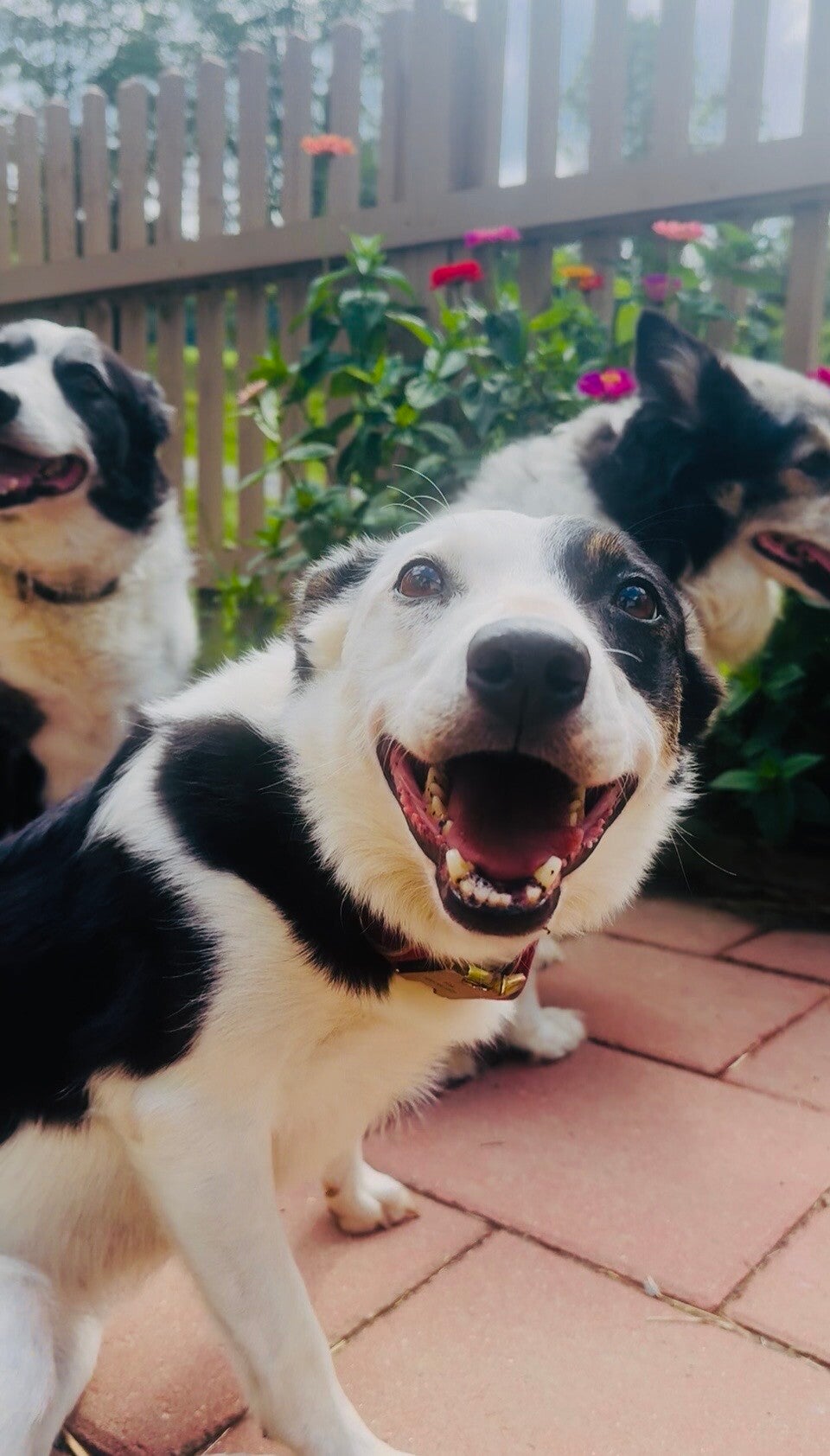
All three of my Border Collies have very strong opinions about where, when and how they would like to be touched.
Bucky is perhaps the clearest communicator. Touch a part of his body he has not approved for touching and he may bite you.
Bear is more diplomatic. He wiggles away.
And Foxy makes a sound I can only describe as somewhere between a growl and an alligator being inconvenienced.
There is very little ambiguity.
Last night, when I tucked Bear in, I was kissing the little spots on his legs. I love spots on animals. Bear got increasingly silly about the whole thing, and somehow I ended up massaging his shoulders.
As I ran my hands over them, I realized I wasn't sure I'd ever really touched him there before.
I told him he had striking bone structure.
This was probably a mistake.
Bear already holds himself in extremely high regard. Everything goes to his head.
But this morning I found myself thinking again about what the vet had said.
Extreme bodily autonomy.
Maybe we should all have some.
Animals seem remarkably untroubled by the idea that their bodies belong to them.
They don't appear to wonder whether saying no will disappoint us. They don't override discomfort because someone they love would prefer a yes. They don't seem to believe affection requires unlimited access.
They simply tell us.
Sometimes with a wiggle.
Sometimes with a growl.
Sometimes, in Bucky's case, with considerably less diplomacy...... and a lot of blood!
Cora and Robbie have their own ways of telling me, too.
There are places they love to be groomed and places they don't. Times they come toward me and times they walk away. Sometimes Robbie wants my hands on that enormous head of his. Sometimes Cora stretches her neck toward the brush as if I could possibly misunderstand what she's requesting. Subtlety has never been one of Cora's great concerns.
And sometimes they're simply done.
One of the things I care about most when people come here is that Cora and Robbie get to keep saying yes and no.
A guest may want to touch them.
The cow still gets a vote.
It seems like such a small thing.
But the more time I spend with animals, the more interested I become in all the ways they don't abandon themselves to make the rest of us comfortable.
Maybe “extreme bodily autonomy” isn't quite so extreme after all.
Maybe it's simply knowing that you belong to yourself.
The Wisdom of Not Trying to Be Wise
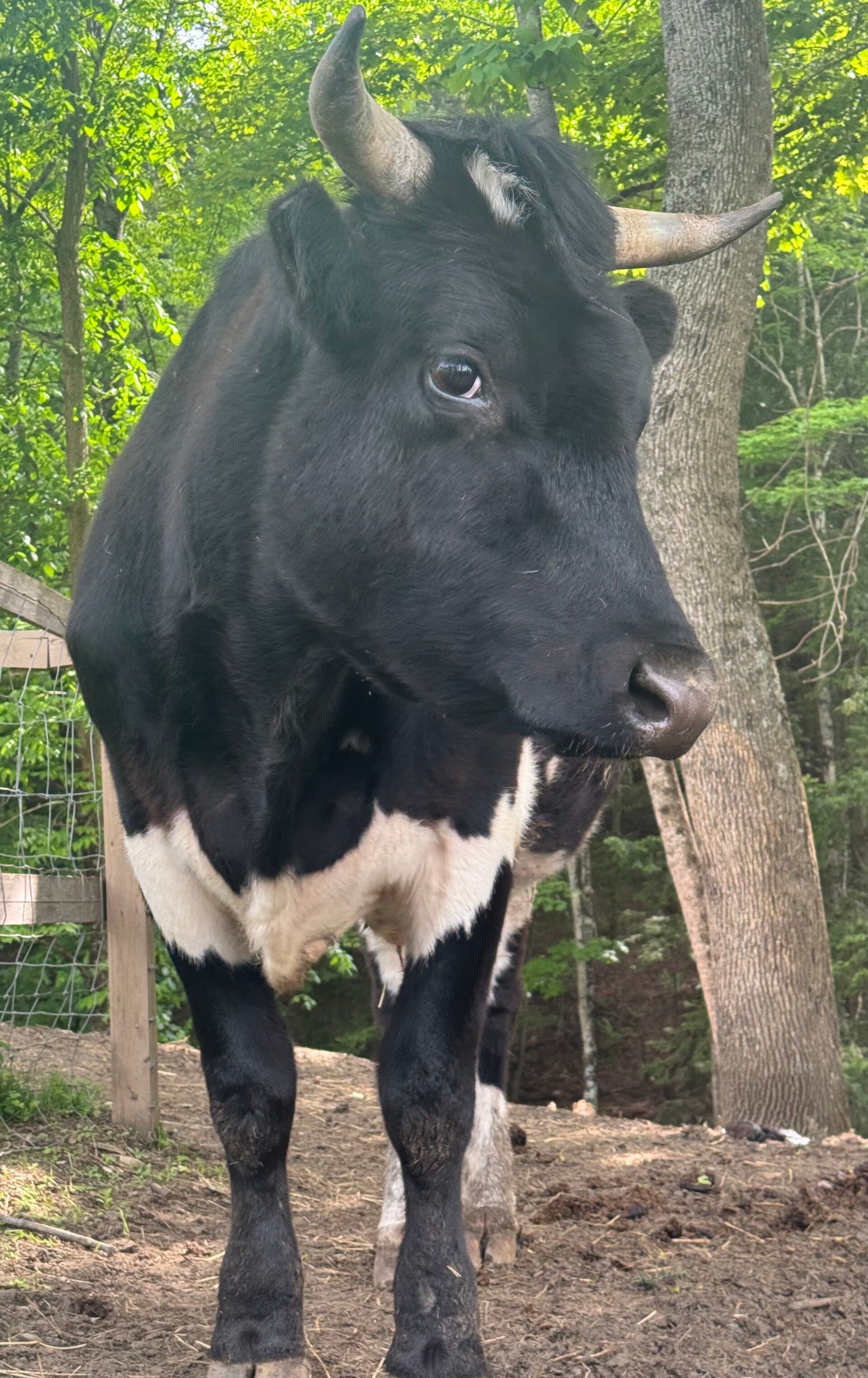
If Robbie could talk, I doubt he'd have much interest in giving advice.
He wouldn't encourage us to live in the moment.
He wouldn't tell us to breathe more deeply.
He certainly wouldn't start a podcast.
He'd probably ask if anyone happened to bring a banana.
That's one of the things I love most about him.
Robbie has never once tried to teach me anything.
Yet somehow... he has.
The older I get, the more I notice how much of life is spent searching for answers. The next book. The next expert. The next technique that promises to make us calmer, happier, healthier, or more present.
Learning is wonderful, of course. I love learning.
But living with Robbie has made me wonder if we've become so busy looking for wisdom...
...that we sometimes walk right past it.
He doesn't try to be present.
He simply is.
When he's curious, he's curious.
When he's tired, he lies down.
Sometimes he'll let out a deep sigh, close his eyes while I'm scratching behind his horns, and for a few quiet moments, it's as though we've both forgotten what time it is.
When he wants affection, he leans his whole enormous body into my hand.
And when he's had enough, he simply wanders off, without the slightest concern about whether I needed a more proper farewell.
He never seems to wish he were somewhere else.
On no level of being whatsoever is Robbie at war with himself.
I'm positive.
How many of us can say that?
If we asked Robbie the secret to relaxing, he'd probably look up from his hay and say,
"Have you tried lying down?"
And honestly...
I think that's refreshingly wise.
Everything about Robbie is genuine.
Maybe that's why I always walk away from him feeling more peaceful than when I arrived.
He's glorious.
Why Time with Cows Can Feel So Different
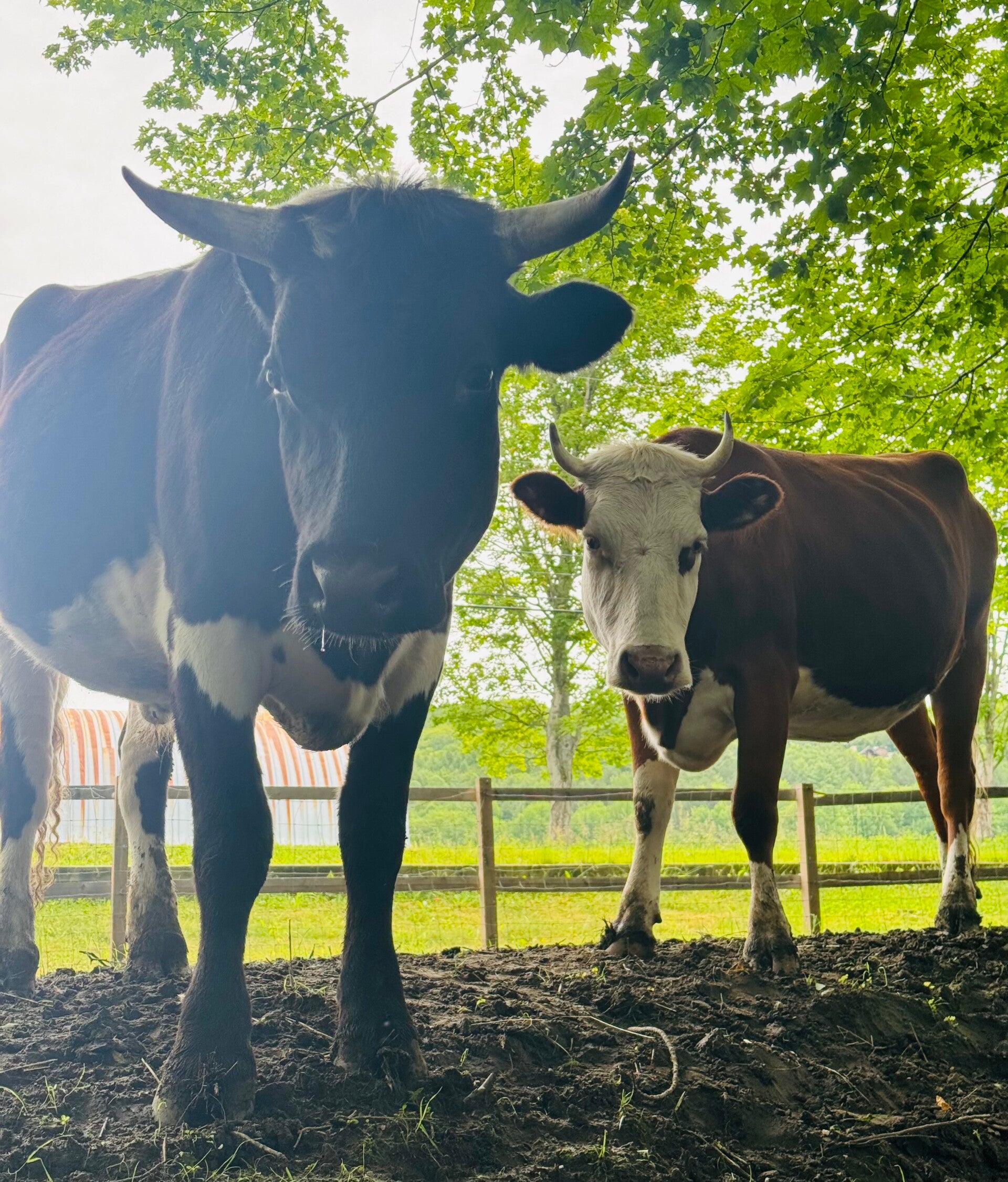
If someone had told me years ago—when I was living in New York City, chasing dreams and imagining a very different future—that two rescued cows would become some of my greatest teachers, I would have smiled politely and thought they were crazy.
Like many people, I simply didn't know cows.
I had no idea what I was missing.
That changed the day Cora and Robbie came into my life.
Both arrived as fragile rescue calves after unimaginably difficult beginnings. Two compassionate women rescued them and lovingly nursed them through their earliest, most fragile months. Robbie was so weak he couldn't even stand for weeks. By the time he was finally strong enough to be on his feet, Cora and Robbie came to Heartstone Farm. Sharing life with them has changed the course of mine in ways I never could have imagined.
The more time I spent with them, the more I found myself wondering why so many of us—including me for most of my life—had underestimated cows.
As it turns out, there's growing interest in that very question.
Research into animal-assisted interventions suggests that spending time with calm animals may help reduce stress, encourage relaxation, and support emotional well-being. Some studies have found decreases in cortisol—the body's primary stress hormone—and improvements in measures associated with relaxation after positive interactions with gentle animals. While much of this research has focused on dogs and horses, people are beginning to discover what farmers, sanctuary workers, and those who live closely with cows have quietly known for a long time: cows are gentle, emotionally expressive animals whose calm presence can have a remarkable effect on us.
I've shared my life with dogs, cats, and horses, spending countless hours riding, caring for, and simply being around them. One horse in particular—my beloved Hooly—will always hold a special place in my heart. Every species offers something unique, and I would never compare one against another.
Cows, however, offer a different kind of experience.
Horses are wonderfully responsive partners. They communicate through movement, awareness, and cooperation, often inviting us into an active relationship. Dogs delight in play, affection, and enthusiastic companionship. Cows seem to ask something entirely different of us. They aren't looking for direction or activity. They invite us to slow down, to become quieter, and simply share space with them. Their unhurried rhythm, steady breathing, and remarkable comfort with stillness often create an atmosphere that feels deeply grounding. Rather than encouraging us to do more, cows gently remind us that sometimes it's enough just to be.
What makes cows especially interesting isn't that they "do" anything to us. They simply go about being cows. They move slowly. They pause often. They graze. They rest. They chew their cud with a steady rhythm. Their breathing is slow and deliberate, and they seem remarkably comfortable with stillness.
Without realizing it, many people begin to match that pace.
Standing beside an animal that weighs well over a thousand pounds has a way of drawing us into the present moment. We naturally become more aware of our own movements, our breathing, and the energy we bring into the interaction. Not because the cow demands it, but because their quiet presence seems to invite it. In a world filled with constant stimulation, that kind of focused attention has become surprisingly rare.
I've never once had to ask a visitor to lower their voice around Cora and Robbie. It simply happens. Conversations become quieter. Breathing slows. Even children often become gentler without being asked. I still find that remarkable.
Cows also experience the world differently than we do. As prey animals, they're naturally attentive to their surroundings and to subtle changes in body language. While they aren't judging us or analyzing us the way people often analyze one another, they do notice how we move and the energy we bring. Their sensitivity gently encourages us to become calmer, quieter, and more intentional without anyone ever asking us to do so.
I've watched this happen over and over again at Heartstone Farm. Visitors often arrive carrying the momentum of busy lives—thinking about work, family responsibilities, travel plans, or the next item on the day's agenda. Yet within a surprisingly short time, many begin to settle into the moment. Voices become softer. Conversations slow. Phones stay tucked away. People begin noticing the warmth of the sun, the breeze moving through the pasture, the rhythmic sound of chewing, the softness in Robbie's eyes, or Cora's unmistakable curiosity. Instead of rushing through an experience, they simply begin experiencing it.
One of the things I treasure most is that nothing is choreographed. Cora and Robbie aren't trained to perform or entertain. If they're curious, they'll wander over. If they'd rather continue grazing for a while, they will. We respect their choices because genuine connection can't be forced. Ironically, it's that freedom that often makes the moments of connection feel so meaningful.
Of course, every visit is different. No two people—and no two cows—are exactly alike. One guest may leave feeling deeply peaceful. Another may leave inspired. Someone else may simply find themselves smiling because Robbie rested nearby or Cora made them laugh with mischievous ways. There is no single "right" experience.
My hope is simply to offer people the opportunity to spend an hour in the company of two remarkable rescue cows who ask nothing of us except that, for a little while, we slow down enough to notice them.
And perhaps, in the process, notice something about ourselves as well.